Renovation of a Former Dormitory into Social Housing for Internally Displaced Persons in Irpin, Ukraine

Context and Overview
Following the full-scale invasion of Ukraine in 2022, millions of Ukrainians were displaced from their homes, creating an urgent demand for safe, affordable, and permanent housing. Many cities and towns faced the dual challenge of hosting internally displaced persons (IDPs) while rebuilding their own war-damaged infrastructure. In Irpin – a city near Kyiv that suffered severe destruction – an abandoned, half-ruined dormitory was transformed into a model of socially oriented reconstruction through a unique collaboration between the Irpin City Administration and the Ukrainian charity organization “Housing for IDPs.”
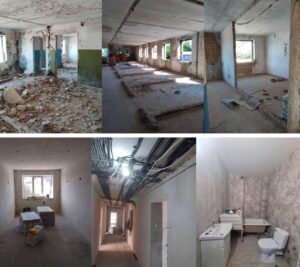
The project aimed not only to restore a derelict building but also to demonstrate how adaptive reuse, social innovation, and cross-sector cooperation can contribute to sustainable post-war urban regeneration. The result is a fully renovated residential building that now provides 19 independent apartments for displaced families, accommodating over 60 residents. The initiative established new legal, social, and design standards for humanitarian housing in Ukraine – bridging emergency response and long-term urban recovery.

Impacts (Cultural, Economic, Social, and Environmental)
The renovation of the former dormitory in Irpin has generated meaningful cultural, economic, social, and environmental impacts.
Culturally, the project preserves an element of Irpin’s architectural and social history. Instead of demolishing the damaged structure, the team chose to restore it, respecting the existing urban fabric while adapting it to new social needs. The renewed building has become a symbol of resilience and rebirth, demonstrating how war-affected cities can rebuild without erasing their identity.
Economically, the project supported local recovery by creating employment for around 60 local specialists during the construction phase, including contractors, engineers, and suppliers. Upon completion, the housing allowed displaced families to reintegrate into the local economy, access jobs, and contribute to small business revitalization in the surrounding area.
Socially, the project delivered safe, stable, and dignified homes for families who had lost everything. The design prioritizes privacy and personal space while providing shared facilities that encourage community interaction. Tenant selection was guided by transparent social criteria, prioritizing women-led households, elderly people, and families with children. This inclusive approach promotes social equity and cohesion among vulnerable groups.
Environmentally, the project minimized its carbon footprint through adaptive reuse, retaining the existing structure and reducing construction waste. Energy-efficient insulation, modern windows, LED lighting, and water-saving fixtures were introduced to lower operational costs and resource consumption. Together, these measures ensure a smaller ecological footprint and a long-term contribution to sustainable urban living.
Overall, more than 60 residents directly benefit from the project, while hundreds more benefit indirectly through job creation, knowledge transfer, and community revitalization. The Irpin initiative serves as a replicable example of how housing reconstruction can simultaneously address cultural continuity, social inclusion, and environmental responsibility.
Strategies and Approaches
The project was guided by an approach centred on adaptive reuse, human-centred design, and long-term sustainability.
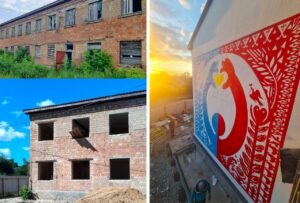
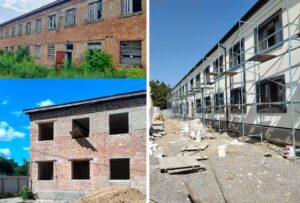
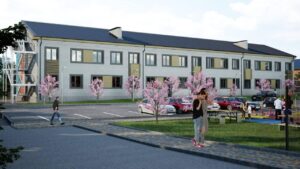
Rather than opting for demolition and new construction, the team chose to repurpose the existing structure, preserving its main framework while reconfiguring the interior layout to modern housing standards. This method reduced construction waste, shortened timelines, and preserved the neighbourhood’s architectural continuity.
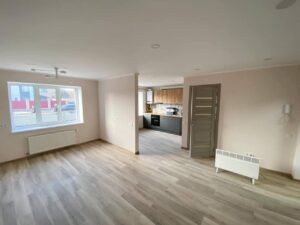
A major design innovation was the conversion of dormitory-style rooms into small but fully independent apartments, each with a private kitchen and bathroom. This reflects Ukrainian cultural norms favouring autonomy and directly responds to the expressed preferences of IDP families for privacy, dignity, and control over their living environment.
The project also introduced advanced engineering solutions to improve resource management. Each apartment was equipped with individual meters for electricity, water, and heating, allowing residents to monitor and regulate their consumption. This system ensures transparent billing and supports responsible energy use – essential for families covering their utility costs but living rent-free.
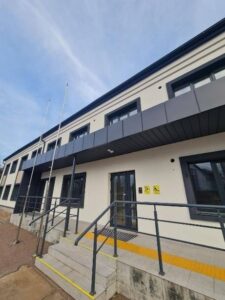
Inclusive and gender-sensitive design principles guided every stage of planning. The building features accessible entrances, secure lighting, and public areas designed to ensure safety and community connection. Family-friendly spaces such as a children’s room and a communal gathering area promote interaction and emotional well-being.
In sum, the Irpin project represents a strategic blend of pragmatism, cultural sensitivity, and technical efficiency, creating a prototype for resilient, inclusive, and environmentally conscious housing solutions in Ukraine’s recovery process.
Policy and Legal Instruments
A defining feature of the Irpin project is its innovative governance and legal framework. The initiative introduced an unprecedented cooperation model between a municipal authority and a charitable organization, developed to ensure both legal compliance and long-term public benefit.
Because Ukrainian legislation did not previously foresee such partnerships for the renovation of public property by non-profit entities, the project engaged international law firms to craft a transparent and replicable legal structure. This framework allowed the charity to fund and manage the renovation while the city retained ownership, ensuring accountability and public control over the asset.
The team also developed a comprehensive roadmap for tenant selection and settlement, ensuring fairness and transparency. Residents occupy the apartments on free-rent terms, covering only utility costs. This approach maintains affordability while encouraging responsible resource use through individual metering systems.
Policy challenges were encountered regarding building permits, utility connections, and the classification of social housing for IDPs. Each issue was resolved collaboratively between municipal authorities and the project team, resulting in new procedural standards that are now shared with other Ukrainian cities.
This framework not only enabled the project’s success but also laid the foundation for policy innovation in Ukraine’s social housing sector – providing a practical model for municipalities and charities to cooperate in post-war reconstruction.

Financing and Economic Instruments
The project was implemented as a charitable, non-profit initiative, combining public, private, and donor resources.
The primary funding for construction, renovation, and furnishing came from international and private donors mobilized by the Ukrainian charity organization Housing for IDPs. The main partner was the Polish development company Dom Development S.A., which contributed significant financial support as part of its corporate social responsibility program. Additional private donations and in-kind contributions covered interior equipment, household appliances, and materials.
The Irpin City Municipality, as the building’s legal owner, provided substantial co-financing. The city financed the development and connection of external utility networks – water, electricity, sewage, and heating – and funded the landscaping and public space improvements around the building.
While the project does not generate profit, it established a sustainable operational model: residents live rent-free but cover their utility costs directly, creating both affordability and self-sufficiency. Transparent accounting and efficient metering systems support ongoing maintenance without financial burden on the municipality or charity.
This hybrid financing structure exemplifies a new model of public–charity partnership, combining donor generosity with municipal commitment to long-term stewardship. It illustrates how blended financing mechanisms can effectively deliver social infrastructure during crisis recovery while maintaining integrity, efficiency, and public ownership.

Indigenous Knowledge and Innovative Technologies
Although not based on historical craftsmanship, the project integrated local construction expertise with modern energy-efficiency technologies to achieve sustainability and user empowerment.
Drawing from Ukrainian traditions of self-reliance and pragmatic resource management, the design prioritized utility efficiency as a cornerstone of affordability. Each apartment was fitted with individual counters for electricity, water, and gas, enabling residents to monitor their consumption and manage their expenses effectively. This was particularly important because IDP families live rent-free but pay for utilities themselves.
Technical innovation included thermal insulation upgrades, replacement of outdated systems with high-efficiency boilers, installation of LED lighting, and double-glazed windows to enhance comfort and reduce energy demand. The adaptive reuse approach minimized embodied carbon and construction waste, offering a low-impact alternative to demolition and new construction.
Digital tools and modern engineering practices supported design coordination and quality control, ensuring cost efficiency and construction precision. At the same time, local builders contributed practical knowledge about Soviet-era building materials and repair methods, ensuring structural integrity and longevity.
Together, these measures combined indigenous knowledge with technological innovation, creating a context-appropriate, low-carbon housing solution that empowers residents, reduces environmental impact, and enhances long-term sustainability.

Innovation
The Irpin project introduced three key innovations – legal, conceptual, and spatial – that distinguish it within Ukraine’s reconstruction landscape.
- Model and Policy Innovation. It was one of the first post-war projects in Ukraine to formalize cooperation between a municipal administration and a charity organization for the renovation of public property. Supported by international legal experts, this framework established a precedent for future partnerships, enabling transparent and accountable collaboration between the public and non-profit sectors.
- Conceptual Innovation. Unlike temporary shelters or modular housing, the Irpin project created permanent, long-term housing designed for stable living. The 19 apartments provide security and dignity for displaced families while offering flexibility for future use – such as accommodating veterans, young professionals, or socially vulnerable residents. This adaptability ensures lasting value and relevance beyond the immediate humanitarian context.
- Functional and Spatial Innovation. The transformation of dormitory-style rooms into independent apartments represents a significant functional shift. Compact private units are complemented by shared social spaces – a children’s room and a gathering area – that foster community interaction and mutual support. This integration of private and collective spaces is still uncommon in Ukraine and offers a new typology of community-oriented social housing.
Collectively, these innovations redefine post-war housing by combining policy creativity, social inclusion, and spatial flexibility – turning a damaged building into a prototype for sustainable urban regeneration.
Reflections
The project also revealed important lessons for future interventions.
One of the main reflections concerns the interdependence of housing and employment in supporting IDP integration. While the project successfully addressed the need for safe and affordable housing, it became evident that stable livelihoods are equally essential for long-term adaptation. Although the building’s location provides convenient transport links to Irpin and Kyiv, limited nearby job opportunities made the site less suitable for some families.
This experience informed a key modification in project methodology: in subsequent initiatives, “Housing for IDPs” and partner municipalities now evaluate employment accessibility – including local labour markets, transport availability, and potential employer cooperation – when selecting future renovation sites.
Another reflection involves post-settlement community engagement. While the project included communal spaces, additional programming and social activities could further strengthen community bonds, support mental well-being, and promote inclusion for women, children, and elderly residents.
These lessons demonstrate the project’s adaptive learning approach – using real-world challenges to refine future practice and build a more holistic understanding of what sustainable social housing entails.
Takeaways
The Irpin project’s experience offers critical insights for Ukraine’s reconstruction and for international partners supporting urban resilience initiatives.
- Replicable partnership model. The collaboration between a municipal authority and a charitable organization, supported by private donors, represents a scalable framework for other cities. The legal and financial model – ensuring transparent investment in municipal property while maintaining public ownership – is already being shared with other Ukrainian communities.
- From emergency to permanence. The project challenges the traditional distinction between humanitarian shelter and long-term housing. By offering durable, adaptable homes with independent utilities and shared community spaces, it demonstrates that permanent social housing can emerge directly from post-crisis recovery.
Building on these lessons, “Housing for IDPs” and partner municipalities plan to replicate this model across Ukraine, focusing on properties with solid existing structures, efficient energy potential, and access to employment and public transport.
The Irpin project shows that even amid war and displacement, it is possible to design housing solutions that are humane, sustainable, and forward-looking – setting new standards for rebuilding not just cities, but communities and lives.